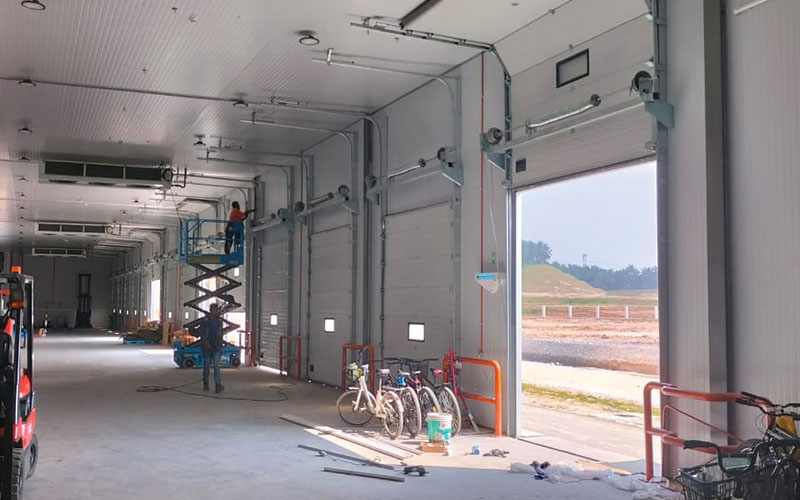
Cold Room sliding door is suitable for all range of cold room from +10°C to -20°C. A heater can be installed on the door blade to prevent the door from frosting in an extreme low temperature room.
The sliding door is using wall guided, there is no modification need on the floor. The sliding door can be motorized upon client request.
Size: Customized
Thickness: 50mm, 75mm or 100mm
Core Insulation: Polyurethane (PUR)
Core Density: 42kg/m3
Cladding: 0.45mm PPGI or 0.5mm 304B Stainless Steel
Accessories: Italy Sliding Door Accessories
Heater type: 35W Constant Heater
Motorized: Optional
Vertical Sliding Door for Cold Room
Vertical sliding door is suitable for all range of cold room from +10°C to -20°C. This is another option when there is space constraint to install sliding door.
Cold Room Swing Door
Cold Room swing door is suitable for all range of cold room from +10°C to -20°C. A heater can be installed on the door blade to prevent the door from frosting in an extreme low temperature room.
Size: Customized
Thickness: 75mm or 100mm
Panel Thickness: 50mm, 75mm, 100mm, 120mm and 150mm
Density: 42kg/m3
Cladding: 0.45mm PPGI, 0.5mm 304B Stainless Steel
Insulation: Rigid Polyurethane Foam
Assembly: Tongue and Groove
Panel Joint System: Semi-Camlock System
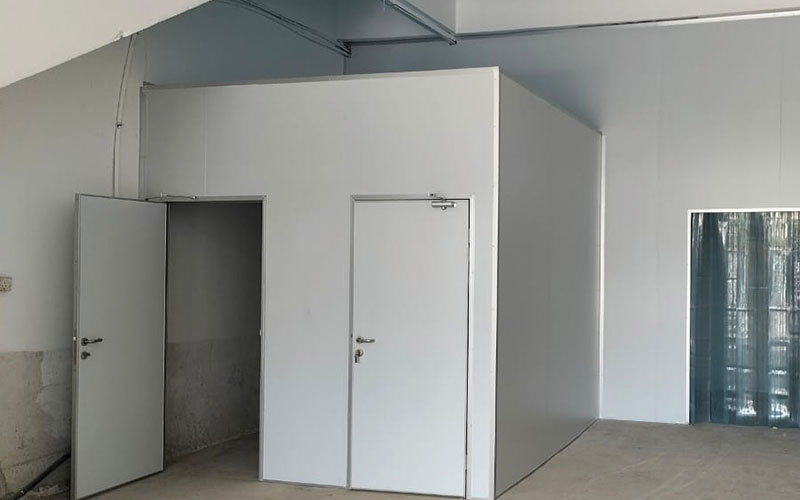
Cabin Door for Cold Room
Polyurethane Insulated Cabin Door, used for technical areas, offices and toilettes.
Hinged
Semi-insulating
Blade thickness 30mm to 50mm
Polyurethane density 42kg/m3
Double blade version available
Applications for Cold Room Doors
Mainly used in areas with a positive temperature (therefore T>0°C), in order to:
Divide areas for the drugs processing, or areas for the blood processing and freezing, from the ones used as offices;
Divide noisy areas (soundproof door) from the ones that must be deafened (for example in the hospitals);
Divide cold areas (thermo-insulating door) from the ones used as offices;
Divide projecting areas from the one used as offices, for example in the Communication and IT industry;
Divide hygienic areas (toilettes, showers) from the dressing room.